Posts

Image
The Wood That Built London A new book has been published which charts the importance of the Great North Wood to the life and development of London. Written by Chris Schüler, who volunteers regularly in the Wood, this book is a must for anyone who knows the Wood and is interested in its place in the history of the area. Of course, as the title suggests, it covers not only Sydenham Hill Wood but the Great North Wood as a whole, fragments of which include the likes of Dulwich Wood, Beaulieu Heights and One Tree Hill. It can be obtained from local booksellers and from internet sites such as Waterstones and Amazon. More information can be found here.... https://sandstonepress.com/books/the-wood-that-built-london
Image
October Update As the days grow shorter, work in the Wood has settled down to general maintenance such as path-work and building dead hedging.    A new stretch of dead hedging has been installed at the junction of the upper path and the connection with the old railway line and Glade. This particular area has been used so intensively, it has become known as the "trampled triangle". It is hoped that the new hedge will allow much of this area to regenerate and early signs are encouraging, as leaf fall beyond the new boundary shows little sign of disturbance.      Another new development has been the installation of new signs.  Many of these are interpretation boards which tell the story of significant places in the Wood, whilst others are clear maps helping to improve navigation. It is hoped that these will help to enhance visitors' enjoyment and understating during their visit.   The smart new entrance sign on the eastern side of Cox's Walk footbridge. O...
Image
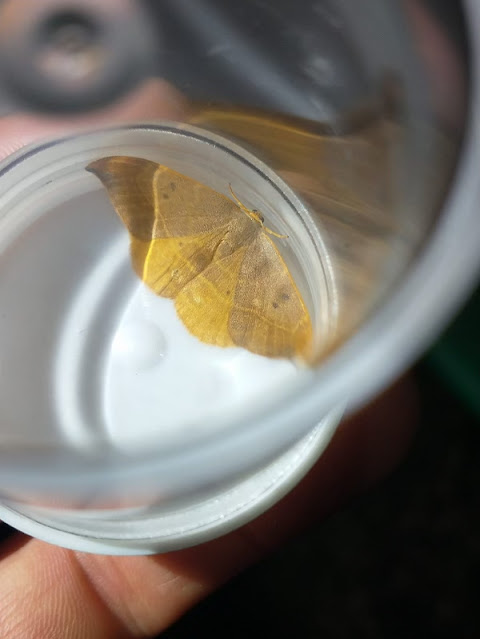
 Moths and Brambles A group of volunteers gathered in the twilight of the glade on Wednesday 15th to carry out a moth survey. A special light box was used to attract moths and trap them safely so they could be checked and released without harm. It has to be said that the results were disappointing to say the least! The group stayed until around 22:00 and by then only one moth had been caught. The box was left overnight and checked the following day and this resulted in only four more. It has to be said that such surveys are best carried out in August but given that September has been a better month for weather, it was expected that a greater number of species and individuals would have been seen. Maybe this is further evidence of the steep decline in insects which is causing scientists such concern.    So what was found?  Oak Hook Tip moth Light Emerald moth Yellow Underwing moth Square-spot Rustic moth   Unfortunately, it was not possible to identify the fifth ...
Image
Autumn on the way. The Dewy Pond in a light shower. Workdays in the Wood have concentrated on preparing it for autumn as well as some general maintenance. Vegetation like brambles, which had been choking the Am Brook was cut back a couple of weeks ago. However volunteers have cleared it back even further to allow more delicate plants a chance to regenerate.  The Am Brook clearly visible, once brambles and nettles have been cut back.   Two years or so ago, a large tree fell down on the upper path and in the process, it took a couple of smaller trees with it. Once the debris had been cleared, the site was opened up into a new g lade, which this spring hosted a wonderful display of foxgloves. The seeds had lain dormant until light levels had increased. It is hoped that this area will see this iconic woodland species spread and establish itself. Foxgloves are bi-annual, first setting seed, the plants emerging the following year but not forming flower spikes until the year after th...
Image
Clearing the Brook The main glade in the late summer sunshine.   During the two most recent workdays (22nd and 25th August), volunteers have worked hard to clear the banks of the Am Brook. The upper section between its source and where it disappears to feed the Dewy Pond, was cleared of vegetation, mainly brambles, which had grown up so  much that the stream was no longer visible. It is hoped that this clearance will allow other native species of plants to have a chance to grow and that it might cut down on nitrate enrichment which is causing eutrophication of the Dewy pond (see last post).    The work was hard and laborious and it was made even more challenging by the large amount of brambles which had to be cleared. A strip of bank a couple of metres wide has been cleared and this has opened up the channel of the Am Brook to show it is still flowing. The cut material was used to build a dead-hedge along the side of the footpath which runs parallel to the book itsel...
Image
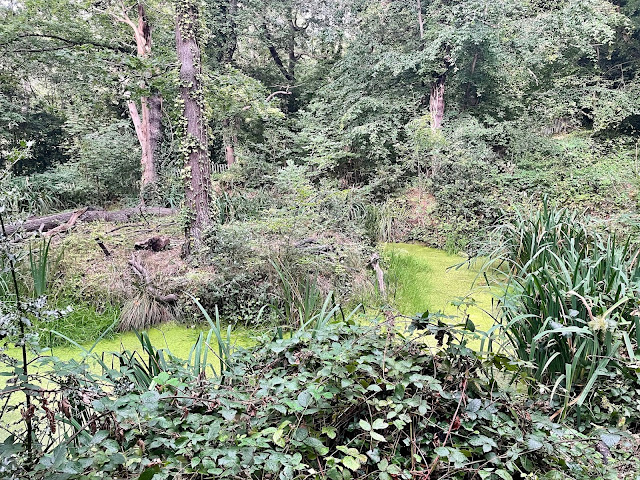
 Pond Life During the workday on 18th August, a group of volunteers carried out a survey of the Dewy Pond. This was completed a little later than usual and unfortunately the amount of pond weed made it difficult to see the organisms in the water. The sampling technique is familiar to anyone who has done pond dipping, as it involves scooping a sample into a white plastic tray of water and studying what might be there.      Thanks to volunteer Kate Lake for leading the survey, then processing and analysing the data.  Observations 1. There was only one predator species found, which was identified as a Small Flat Diving Beetle. The diving beetle found in the Dewey Pond. Photo David Ward 2. It was significant that no dragonfly larvae were found as usually they are fairly abundant, nor were there any water boatmen.    3. Daphnia or water fleas were numerous and in some samples, they were teeming. Furthermore, their colouration was red, which suggests low oxy...
Image
July Work Update Summer is a a quiet time for working in the Wood. The bird nesting season from April to October means that cutting back invasive species like cherry laurel and rhododendron has to be put on hold. Therefore work concentrates on repairs and general maintenance. For example, during the previous two workdays, volunteers have worked their way along Sydenham Hill cutting back vegetation which has grown out over the pavement and pruned any branches that were getting in the way of pedestrians. Another important job was to clear out the drainage channel at the Crescent Wood Rd entrance , as the recent heavy rainfall has overwhelmed the drain on the road, sending torrents of water into the Wood.    Another very important job will be to skim the duck weed off the surface of the Dewey pond. The pond is fed by the Am Brook, which rises as a spring less than a hundred metres away. The water percolates down through the Claygate Beds which are made up of sand silt and clay a...