Posts

Image
Storms in the Wood The recent storms have brought down some trees in the Wood, some of them being quite substantial. Often, the tree has become old and weak and if covered in ivy, the extra weight can destabilise  it, making it vulnerable to being blown down in particularly strong winds. A sycamore was brought down during Storm Isha on the 21st January and the fallen tree blocked the upper path leading from Cox's Walk eastern entrance. Luckily it fell during the night when no-one was around. The path was reopened  on Tuesday by Sydenham Hill Wood Conservation Officer, Sam Taylor after he had sawn off the tops of the branches which were blocking the way. On Wednesday, volunteers carried on the clearing up job. The fallen sycamore blocking the path (photo Sam Taylor) The path cleared and reopened  (photo Sam Taylor) Elsewhere in the Wood, volunteers have created a hurdle made of woven hazel to protect an area of wood anemones. Hurdles are a sustainable way o...
Image
New Year, New Bridge  The reconstruction of the Cox's Walk footbridge is getting under way in earnest. From today (15th January), Cox's walk will be closed from the gate opposite the derelict Grove Tavern on the South Circular up to and across the bridge to the junction with Lapsewood Walk. This is done for safety reasons as heavy machinery will be at work in the area. This means that entry to the Wood will be possible only from Crescent Wood Rd and through Dulwich Wood.  Map showing diversionary routes during bridge reconstruction. View from the western side of the bridge, one of the saved oaks seen up against the green hoarding. Bridge reconstruction from the western entrance from Cox's Walk Elsewhere in the Wood, the storms over the Christmas and New Year period have brought down a number of trees. It is always sad to see large and venerable trees being felled by the winds but it is a natural part of woodland regeneration. The opening up of woodland floor to light will...
Image
Bridge Progress 2  A dramatic change has happened in the last two weeks. The old decking has been removed along with the wooden superstructure and side railings. 
Image
Bridge Progress  Scaffolding is now complete around the bridge. In the photo, a winch and pulley rig sits on the deck to help lift materials and equipment. 
Image
New Developments in the Wood It's been a few months since the last post and  the rhythm of work in the Wood has settled down to general maintenance of paths, fences and dead hedges, along with routine surveys of the wildlife that makes its home here. However, there are two major developments which, it is expected,  will bring huge benefits to the Wood and its users in the near future.  Firstly, the Wildlife Trust has been successful in its bid for funding to put together a plan to reunite both Sydenham Hill and Dulwich Woods. Although, in effect, the same fragment of the Great North Wood, they have very different characteristics and management.  The majority of Sydenham Hill Wood lies to the east of the old railway track alignment of the High Level line that used to bring visitors to Crystal Palace. Closed in 1954, the route has, in parts returned to nature and the longest section of this runs through the Wood to the tunnel which took it through t...
Image
Hurdles  A different type of path edging is being tried in the Wood.  New hazel hurdles on the path down to the tunnel. Making hurdles is an old woodland craft. Volunteers in the Wood have been coppicing hazel and using the cut material to make hurdles. These are being used as edging for the main path coming down from Crescent Wood Road to the old railway path. They are a pleasing alternative to dead-hedging and given the restricted space available, they fit the purpose well.  The process involves driving hazel stakes in the ground at around 50cm intervals. Long lengths of hazel are split lengthways to provide the material to fill in the gaps.  Splitting the hazel makes it more flexible and easier to weave in and out of the stakes. Hurdles can also be made as panels by using a wooden base into which the stakes are fixed. The split hazel is woven in and out of the stakes and when the planet is complete, the vertical st...
Image
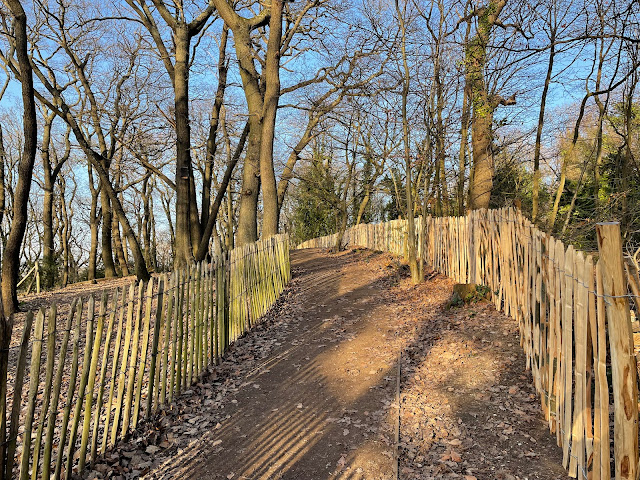
New Year Update  The New Year has seen plenty of activity in the Wood. Volunteers have been hard at work replacing fencing in various locations.  Some people ask why some parts of the Wood are fenced off.  It is necessary to restrict access to selected areas in order to protect ground layer plants from trampling and compaction. It is useful to have a look at the adjacent Dulwich Wood where there is no such protection of vulnerable areas. In much of that wood, there is little or no ground cover, with the trees emerging from bare earth.  Woodland shouldn't be like that, and a healthy ecosystem should have vertical layers in it, which support different species of birds and insects. Some butterflies, for example, forage in the upper branches of trees, whilst many more need healthy ground vegetation. Without that ground cover, they will not colonise the wood.  The same goes for other insects and small mammals like wood mic...