Posts

Image
New Developments in the Wood It's been a few months since the last post and  the rhythm of work in the Wood has settled down to general maintenance of paths, fences and dead hedges, along with routine surveys of the wildlife that makes its home here. However, there are two major developments which, it is expected,  will bring huge benefits to the Wood and its users in the near future.  Firstly, the Wildlife Trust has been successful in its bid for funding to put together a plan to reunite both Sydenham Hill and Dulwich Woods. Although, in effect, the same fragment of the Great North Wood, they have very different characteristics and management.  The majority of Sydenham Hill Wood lies to the east of the old railway track alignment of the High Level line that used to bring visitors to Crystal Palace. Closed in 1954, the route has, in parts returned to nature and the longest section of this runs through the Wood to the tunnel which took it through t...
Image
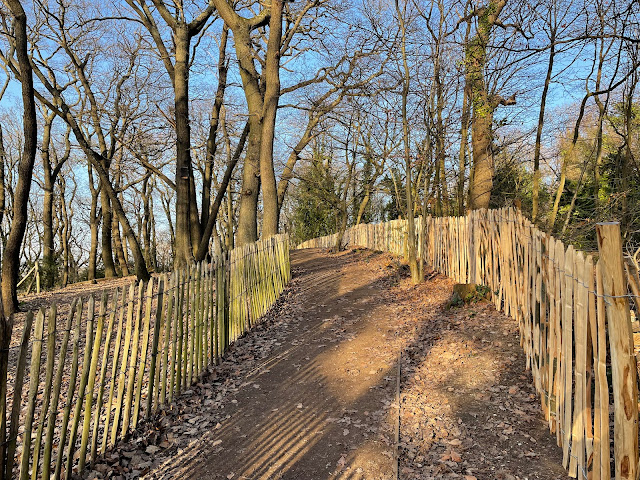
Hurdles  A different type of path edging is being tried in the Wood.  New hazel hurdles on the path down to the tunnel. Making hurdles is an old woodland craft. Volunteers in the Wood have been coppicing hazel and using the cut material to make hurdles. These are being used as edging for the main path coming down from Crescent Wood Road to the old railway path. They are a pleasing alternative to dead-hedging and given the restricted space available, they fit the purpose well.  The process involves driving hazel stakes in the ground at around 50cm intervals. Long lengths of hazel are split lengthways to provide the material to fill in the gaps.  Splitting the hazel makes it more flexible and easier to weave in and out of the stakes. Hurdles can also be made as panels by using a wooden base into which the stakes are fixed. The split hazel is woven in and out of the stakes and when the planet is complete, the vertical st...
Image
New Year Update  The New Year has seen plenty of activity in the Wood. Volunteers have been hard at work replacing fencing in various locations.  Some people ask why some parts of the Wood are fenced off.  It is necessary to restrict access to selected areas in order to protect ground layer plants from trampling and compaction. It is useful to have a look at the adjacent Dulwich Wood where there is no such protection of vulnerable areas. In much of that wood, there is little or no ground cover, with the trees emerging from bare earth.  Woodland shouldn't be like that, and a healthy ecosystem should have vertical layers in it, which support different species of birds and insects. Some butterflies, for example, forage in the upper branches of trees, whilst many more need healthy ground vegetation. Without that ground cover, they will not colonise the wood.  The same goes for other insects and small mammals like wood mic...
Image
Autumn comes to the Wood Wrinkled Peach fungus . (Photo by Chris Cannelle) As the evenings draw in and the weather has become cooler and wetter, autumn has certainly arrived in the Wood. With it has come an explosion of fungi, but especially exciting has been the discovery that the very rare Wrinkled Peach fungus is growing in the Wood. This fungus is on the global red list of endangered fungi, so it is especially important that it has been discovered in the Wood. These amazing photos of the fungi were taken by Wood volunteer and fungi expert, Chris Cannelle. (Photo by Chris Cannelle) Elsewhere, path improvements have continued. Contractors have done an excellent job in extending the improved path network, linking the Cedar of Lebanon boardwalk with the folly and on from there, through the "trampled triangle" to the previously improved section.  Improved path leading up from the Folly to the Cedar of Lebanon.  I mprovements in the "trampled triangle", the new path t...
Image
Pathway Progress Volunteers have worked hard over the last few weeks on rebuilding the path from the Folly to the old railway alignment which carries the main path through the Wood. The path reconstruction was necessary as parts of it became waterlogged and muddy, especially in winter. It has been surfaced with limestone chippings, which it is hoped will help water to drain through keeping the path from being swamped.  At last, on Wednesday 7th September, the task was completed.  Celebrating completion of the path. ( Photo: Pennie Hedge ) The completed path ( Photo: David Ward ) The day's work didn't stop at the path, as during the morning, a group of volunteers worked hard to cut back vegetation in the Glade to ensure that smaller plants like the bluebells have a chance next year. After lunch, this group joined the others working on the path reconstruction so helping to complete that job. Clearing the Glade ( Photos: Pennie Hedge )
Image
Moth Survey  Work in the Wood has settled into a routine of maintenance and improvement. The exceptionally dry and warm weather has presented challenges and opportunities. The small pond has dried out completely but this has allowed excess sediment to be dug from the bed so when it refills, the water should be deeper and clearer. The hedge planted in the winter is showing sign of distress as  the young plants have been unable to establish themselves with roots deep enough to seek water. Consequently, volunteers have had to transport water from Peckarman's Wood all the way across to Cox's Walk steps. Hopefully this has saved many of the young plants from succumbing to drought.  Following on from the Dewey Pond survey in June,  on the evening of 23rd August,  moth traps were set up in two secure sections of the Wood. The following day, the number and type of moths were recorded and the moths released unharmed. The resul...
Image
Dewy Pond Survey   2022 A dragonfly nymph found in the Dewy Pond. 1st June saw the annual Dewy Pond survey carried out by volunteers and led by Kate Lake, herself an experienced volunteer in the Wood. Many thanks to Kate for leading the survey, collating the results and analysing them. The results are similar to the last survey which was carried out on 18th August last year, though there was lower diversity in that slightly fewer species were recorded.  Also there were no swimming mayfly nymphs, a common species that is semi-sensitive to oxygen levels and these have been observed during many years of surveys of invertebrates in the pond.  Dragonfly nymphs were not found whilst doing the survey, however after it was concluded, a volunteer located the best spot and found two large nymphs (see photo above). However, this did not make up for the fact that their numbers were very low.  Also the only water boatmen found were when pondweed was being cleared and not during t...